
How I Discovered the Hidden Language of the Subconscious
Years ago, I was sitting in a classroom at Orange Coast College in Southern California. I had just completed my certification in Clinical Hypnotherapy, and on our final day, Dr. John Davis made a recommendation that would significantly influence both my personal development and the way I would eventually work with clients.
He suggested that those of us who wanted to continue our own personal work and expand our understanding of the mind take a class taught by Dr. Chuck Leviton, a clinical social worker who taught psychosynthesis.
So I signed up.
Psychosynthesis is an approach to psychology and personal development that explores the different aspects or “parts” of the self and seeks greater awareness and integration among them.
But this wasn't primarily a class about theory.
Chuck introduced us to interactive imagery.
At first, I struggled with it.
I wasn't particularly good at visualizing. I wondered whether I was doing the exercises correctly. And quite often, when an image, character, place, or response appeared in my mind, my immediate reaction was:
I'm just making this up.
Looking back, I think that reaction is one of the most interesting aspects of imagery work.
We're accustomed to placing a great deal of value on conscious thought. We analyze. We reason. We explain. We try to understand why we feel or behave the way we do.
Imagery asks us to temporarily do something different.
Instead of immediately interpreting what arises, we observe it.
Each week for ten weeks, Chuck guided us through a different imagery experience. We would close our eyes, enter the imagery, interact with what emerged, and then journal about the experience before discussing it with the group.
I began noticing images, words, emotions, physical sensations, memories, characters, environments, and unexpected associations.
More importantly, I discovered that the imagery could be interactive.
Rather than simply observing a symbol, I could engage with it.
I could ask it a question.
I could notice how it responded.
I could ask what it represented or what it wanted me to understand.
That opened an entirely different way of exploring psychological material.
Instead of asking the conscious mind to explain everything, imagery provided a way to approach experience through symbol, metaphor, association, sensation, and spontaneous response.
That distinction became increasingly important in my work.
There are things we know consciously. We can describe them, analyze them, and discuss them.
But there are also patterns, associations, emotional responses, internal conflicts, and implicit understandings that may be difficult to access through direct questioning alone.
Imagery can provide another route into that material.
And because the imagery is symbolic, its meaning isn't necessarily obvious at first.
A house may appear.
A locked room.
An animal.
A storm.
A child.
A bridge.
A completely unexpected character.
The temptation is to immediately decide what the symbol means. But one of the most useful things I learned was to stay curious before interpreting.
What happens if you approach the image rather than explain it?
What happens if you ask the character a question?
What happens if you open the door?
What happens if you ask the image what it represents?
Sometimes the response is surprising.
Over time, I became increasingly comfortable working with this symbolic language, and imagery eventually became one of the tools that influenced how I approached hypnosis, parts work, emotional processing, and personal transformation.
It also taught me an important lesson about the phrase “I'm making this up.”
Of course you're making an image in your mind.
That's what imagination does.
The more useful question is:
Why did your mind create that particular image?
Why that house?
Why that person?
Why that memory?
Why that sensation?
Why did the door appear locked instead of open?
Why did the character say that?
Instead of dismissing spontaneous imagery because it was internally generated, I learned to become curious about what the imagery might reveal.
That shift changed my relationship with the subconscious.
I walked into Chuck's class expecting to learn another personal-development technique.
I walked out understanding that the mind communicates in more ways than conscious language and linear thought.
Sometimes the most interesting material emerges when we stop asking the conscious mind to provide all the answers and give the deeper mind another way to speak.
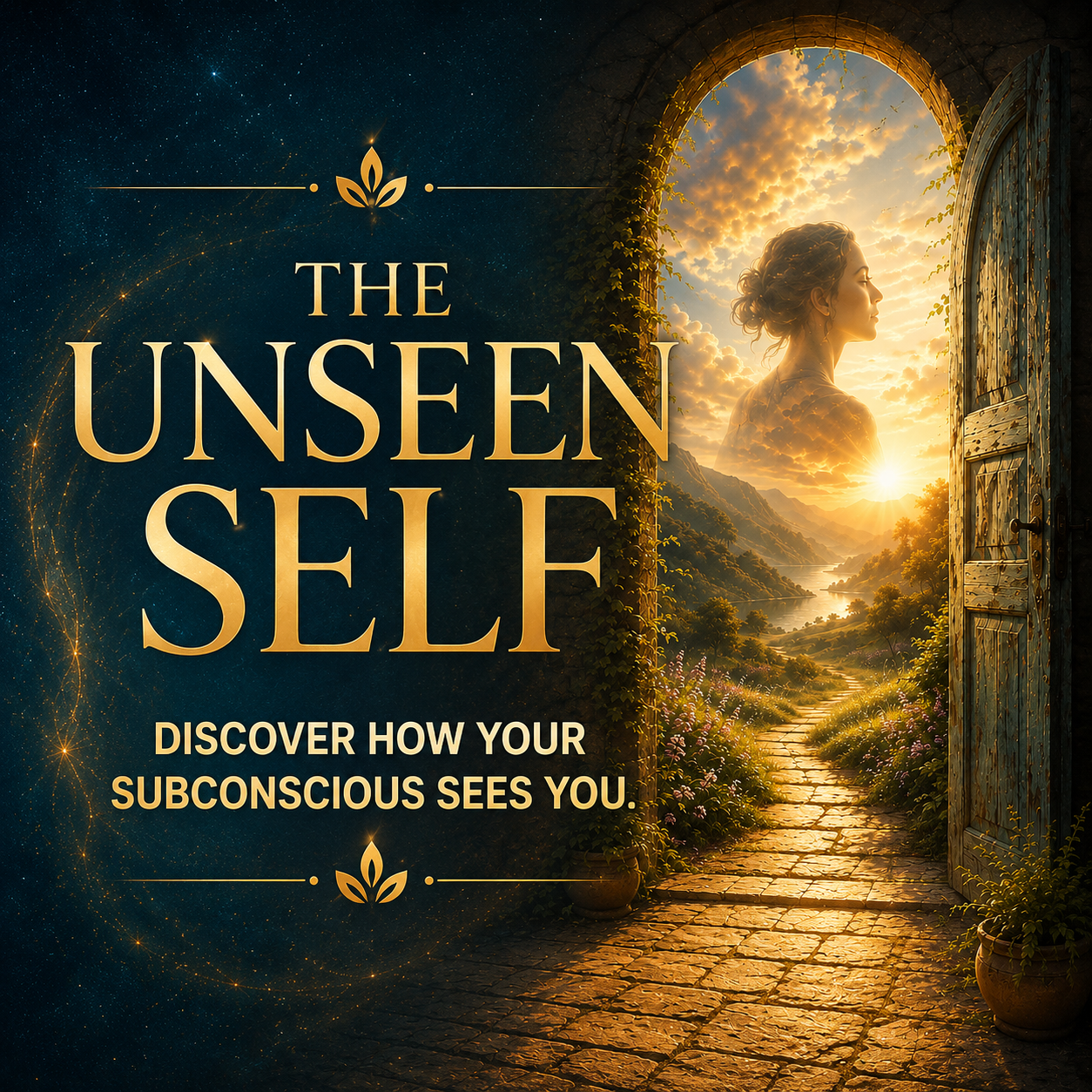
That is the experience behind The Unseen Self, the first workshop in my new Interactive Imagery series.
It's an opportunity to experience this process rather than simply learn about it: enter the imagery, observe what emerges, interact with it, journal it, and explore what your own subconscious may be communicating.
In honor of my mentors in this field Dr. Chuck Leviton and his wife Patti, I now teach and certify in this amazing modality. Check out the training information here.
